What Are OECMs?
The term Other Effective Area-Based Conservation Measures (OECMs) was first formally defined through CBD Decision 14/8 in 2018 (CBD, 2018). OECMs are defined as “geographically defined areas other than protected areas, which are governed and managed in ways that achieve positive and sustained long-term outcomes for the in situ conservation of biodiversity, with associated ecosystem functions and services and, where applicable, cultural, spiritual, socio-economic, and other locally relevant values” (CBD, 2018; Dudley et al., 2018).
This definition marks an important shift in the global approach to conservation. While protected areas focus on conservation objectives, OECMs emphasize conservation outcomes. This means that areas managed for various purposes, such as fisheries, cultural protection, or private-sector use, may be recognized as OECMs if they are proven to make a tangible and sustained contribution to biodiversity conservation (Jonas et al., 2021; Maxwell et al., 2020).
Through the Kunming-Montreal Global Biodiversity Framework (KMGBF), the global community has committed under Target 3 to ensure that by 2030 at least 30% of the world’s terrestrial and marine areas are effectively conserved and managed through protected areas and OECMs (30×30). In Indonesia, the Ministry of Marine Affairs and Fisheries (MMAF), as the authority responsible for marine and coastal biodiversity, has made a commitment through the implementation of five Blue Economy strategic programmes through 2045. The first priority programme of the MMAF Blue Economy agenda is to expand marine protected areas to cover 30% of Indonesia’s marine areas by 2045 (30×45).
In the national policy context, the OECM concept has been adopted in the Draft Government Regulation on Fishery Resources Conservation (RPP KSDI) under the term Kawasan Berdampak Konservasi (KBK), or Conservation Impact Areas. KBK is defined as:
“areas outside conservation areas, located in waters, coastal areas, and small islands, whose ecological conditions are maintained and managed to support conservation functions.”
Under the Draft Government Regulation on Fishery Resources Conservation, an area may be identified as a KBK if it meets the following criteria:
- Has clearly defined geographical boundaries;
- Is managed and utilized by specific parties;
- Provides benefits for fishery resources and their environment; and
- Performs functions within the ecosystem and other sectors.
What Is the Potential for KBK in Indonesia?
From 2024 to 2026, spatial data were collected from various sources across NGOs and government institutions. Initial data showed overlaps with existing conservation areas, making in-depth verification necessary to establish whether the management arrangements justify potential KBK status. As of 2026, the indicative map of potential KBK in Indonesian waters covers 9.7 million hectares across 650 sites throughout the country. Indonesia’s potential marine KBK areas have been integrated into the Ministry of Marine Affairs and Fisheries’ SIDAKO platform: https://sidako.kkp.go.id/sidako/oecm .
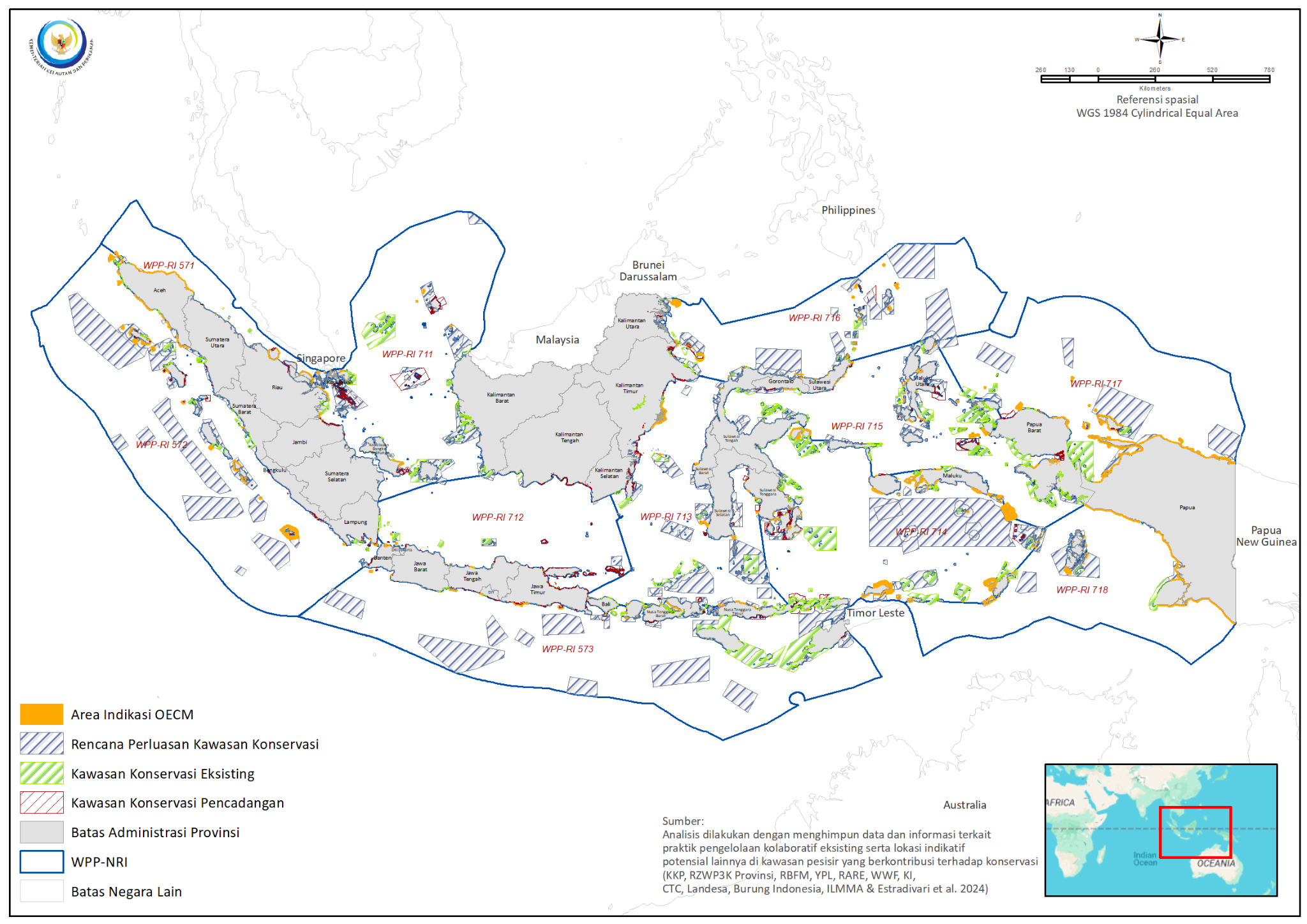
Potential for OECM Management Units in Indonesian Waters
|
Potential Management Entity |
Number of Areas |
Percentage (%) |
|
Indigenous Peoples |
320 |
49.23 |
|
Local Communities |
178 |
27.38 |
|
MHA |
31 |
4.77 |
|
Government |
81 |
12.46 |
|
Private Sector |
40 |
6.15 |
|
Total |
650 |
100.00 |
What Is the Policy and Operational Framework for Marine KBK in Indonesia?
Indonesia is developing a policy foundation to ensure that potential OECMs can be assessed and recognized in ways that are adapted to specific local contexts. The OECM concept has been adopted by the Ministry of Marine Affairs and Fisheries (MMAF) using the term KBK (Kawasan Berdampak Konservasi), as included in the revised Draft Government Regulation on Fishery Resources Conservation (RPP KSDI), which revises Government Regulation No. 60 of 2007.
To support implementation, the KBK policy framework is complemented by the KBK Guidelines and the SLAT-KBK (Site-Level Assessment Tool), which serve as operational instruments at the site level. The KBK Guidelines provide technical direction on the stages of identification, assessment, verification, documentation, and management of KBK areas, including the relevant criteria, indicators, and procedures. Meanwhile, SLAT-KBK helps assess an area’s eligibility and readiness based on the preliminary requirements and four main criteria: clearly defined geographical boundaries; management and use by specific parties; benefits for fishery resources and the environment; and functions within the ecosystem and other sectors.
Other Effective Area-Based Conservation Measures (OECMs) expand the range of conservation approaches beyond Marine Protected Areas (MPAs) by formally recognizing diverse governance systems and resource-management practices. This approach enables more inclusive conservation by respecting traditional management rights and cultural practices while delivering ecological, social, economic, and spiritual benefits. In doing so, OECMs strengthen the resilience of marine ecosystems and reaffirm the important role of local communities as stewards of biodiversity.
The OECM concept was introduced in 2010 by the Conference of the Parties to the Convention on Biological Diversity (CBD). In 2018, the Parties formally adopted the following definition:
“A geographically defined area other than a Protected Area, which is governed and managed in ways that achieve positive and sustained long-term outcomes for the in situ conservation of biodiversity, with associated ecosystem functions and services and, where applicable, cultural, spiritual, socio-economic, and other locally relevant values.”
Since then, the International Union for Conservation of Nature (IUCN) has provided technical guidance to help countries identify and report OECMs in line with the CBD framework.
Indonesia recognizes OECMs as an important complement to Marine Protected Areas (MPAs) in achieving the target of conserving 30% of its marine areas by 2045. In March 2024, a multi-stakeholder workshop led by the Ministry of Marine Affairs and Fisheries established the following national definition:
“Coastal waters and small islands, offshore marine areas, and deep-sea areas that are geographically located outside conservation areas and are managed by government institutions, universities, research institutions, the private sector, and/or communities through governance arrangements that deliver conservation impacts for ecological, biodiversity, social, economic, and/or cultural aspects.”
At the national level, these areas are known as Kawasan Berdampak Konservasi (KBK), or Conservation Impact Areas. The term Kawasan Perairan dengan Dampak Konservasi (KPDK), or Waters with Conservation Impact, is used when referring specifically to marine and coastal areas. These areas may include inland waters, coastal areas, small islands, offshore waters, and the deep sea located outside formal MPAs, but still managed by communities, customary authorities, academic institutions, private entities, or government institutions in ways that make a tangible contribution to biodiversity conservation. Indigenous Peoples and local communities play a central role by applying customary rules, traditions, and collective agreements that safeguard biodiversity while supporting livelihoods. Recognizing and supporting these community-based management systems is an important step towards achieving biodiversity conservation targets at both national and global levels.
Traditional Management Systems
Indonesia recognizes traditional marine management systems as an important part of OECMs, including:
The operational criteria for marine KBK in Indonesia, used for identification, assessment, and recognition, are:
- Prerequisite criterion: The area must be located outside conservation areas designated by the government
- Four main criteria
- Clearly defined geographical boundaries;
- Managed and utilized by specific parties;
- Provides benefits for fishery resources and their environment; and
- Performs functions within the ecosystem and other sectors.
KBK Typologies
KBK Typologies Based on Management Objectives
|
Ecosystem and Ecological Function Protection |
Protect important habitats, key species, and ecosystem services, and restore degraded habitats. |
|
Cultural and/or Customary Values |
Protect areas, cultural values, and community spiritual practices through customary rules. |
|
Sustainable Fisheries or Aquaculture |
Maintain the sustainability of fishery resources through fishing-gear regulations, no-take zones, and environmentally responsible fishing practices. |
|
Sustainable Tourism |
Develop tourism that safeguards ecosystem integrity while providing economic benefits to communities. |
|
Special Interests (Research/Education, Military, Transport, Infrastructure, etc.) |
Protect aquatic areas used for purposes such as research, education, military activities, and infrastructure while maintaining the sustainability of marine ecosystems. |
KBK Typologies Based on Management Actors
|
Indigenous (Customary Law) Communities |
Manage areas based on customary law, cultural norms, and local wisdom to ensure the sustainability of resources and ecosystems. |
|
Local and Traditional Communities |
Manage areas through participatory, sustainable traditional practices that protect ecosystems and support food security. |
|
Academic and Research Institutions |
Conduct research and monitoring, and develop environmentally friendly technologies as a basis for evidence-based management. |
|
Non-Governmental Organizations (NGOs) or Community Self-Help Groups |
Support conservation through advocacy, community empowerment, habitat restoration, and multi-stakeholder collaboration. |
|
Companies or Private-Sector Entities |
Integrate environmental protection and sustainable business practices into business operations and environmental responsibility efforts. |
|
Local or Central Government |
Regulate and designate areas, issue permits, conduct oversight, and manage aquatic resources in accordance with policies and regulations. |
|
Other Formal Institutions |
Support area management through regulation, funding, research, empowerment, and community capacity strengthening. |
KBK Identification and Recognition Process
The identification and recognition process for marine KBK in Indonesia consists of six main steps:
- Pre-proposal: Identify initial potential areas.
- KBK proposal: Voluntary submission of documents.
- Administrative verification: Check the completeness of the submitted documents.
- Technical validation: Conduct a field-based suitability assessment.
- Recognition decision: Official decision by the authorized official.
- Registration and integration: Record the area in the national database and regional spatial planning system.
According to the MMAF and OECM 2045 Vision, a site must meet the following criteria to be considered an OECM Candidate:
- It is located outside an MPA designated by the government;
- It has established governance arrangements and institutional structures;
- It has high biodiversity value and a monitoring plan; and
- It provides significant ecological, social, cultural, or economic benefits.
- An area that meets the OECM definition, the first criterion, and at least one of the other criteria is categorized as a Potential OECM.
Current Status
OECM definitions and criteria have been developed and tested at 10 pilot sites across Indonesia, covering spatial, institutional, and biodiversity aspects, as well as social, economic, and cultural dimensions.
Potential OECM Areas
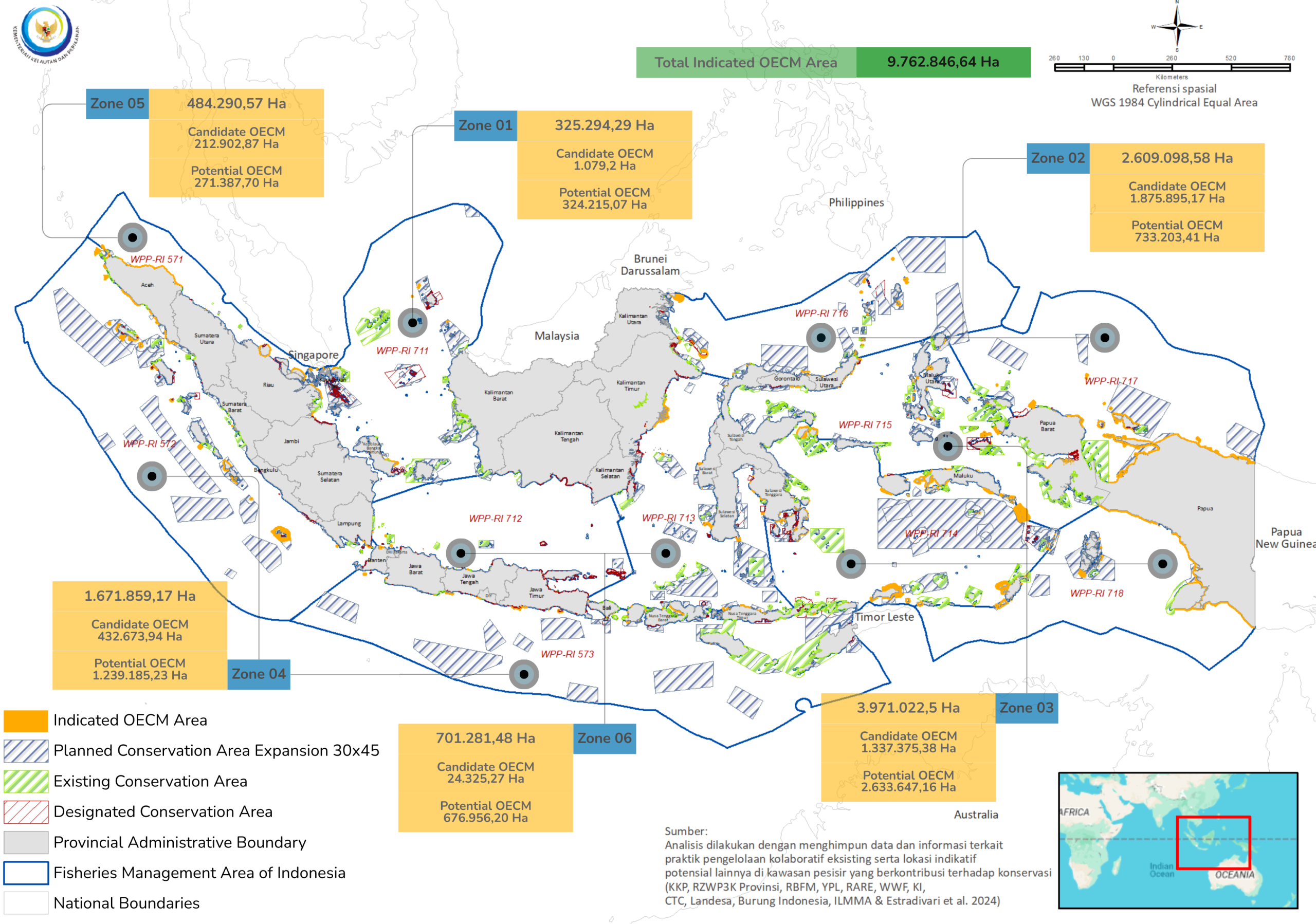
Based on the latest mapping and analysis, approximately 9.763 million hectares of Indonesian marine waters have been identified as OECM Candidates or Potential OECMs. To support biodiversity conservation and sustainable marine resource management, the development of thematic OECM strategies needs to align with the three main objectives of the 30×45 Vision:
- Marine biodiversity protection
- Sustainable fisheries
- Blue carbon
These categories were established through an initial identification process that included an in-depth review of key ecological features and biodiversity across Indonesia’s seascapes. By combining spatial and thematic approaches, this initiative aims to complement the national conservation system and contribute to global biodiversity targets.
Indonesia’s OECM implementation plan provides an additional pathway towards achieving the 30×45 Vision and will be implemented in two phases:
- 199 sites (2025–2030) – OECM Candidates
- 451 sites (2031–2045) – Potential OECMs